
Introduction
At the time of crisis when the world is hit hard by the Pandemic Covid-19 and there is no sign of credible recovery mechanism in the upcoming few months, it becomes obligatory on the part of people and institutions to live with it and adjust accordingly. Undoubtedly, the best way to move forward is to avail the assistance of digital platform. It’s a well known fact that no sector has remained untouched by the crisis and the education sector is no exception which has been hit severely, provided the transition phase going on in the form of semester examination and new admissions. The most affected are the Board students who wish to enroll in higher education and the final year college students who are excited to move ahead in their career. Banaras Hindu University, one of the prominent institutions in the higher education sector is also facing the same problem i.e. conducting entrance examination for new admissions and semester examinations of already enrolled students. Moreover, students are also eager to know about the future course of actions. Of course, digitalization of education system can prove to be much helpful, but there are various problems associated with it as well. This report aims to understand the mindset of students towards coping up with the potential challenges through online curriculum and evaluation system. For extraction of credible and reliable data, more than 1100 B.H.U. students were surveyed in order to delve deep into the issues and prospects of the online education, examination and evaluation procedure.
Objectives-
This report is concretely focused on achieving following objectives:
• To assess the impact of Covid -19 on the functioning of regular academic session of B.H.U, a pioneer in the field of higher education.
• To understand the opinion of students of B.H.U. regarding conduct of Online Semester examination and the pattern of examination i.e. Objective or Subjective Pattern.
• To know about evaluation criteria which students prefer for internal assessment.
• To insinuate measures to cope with the challenges involved in evaluation procedure keeping in consideration the opinion of concerned students.
• To present a vision for broadening e-learning platforms to reach the remote people, especially in higher education.
Challenges with respect to online examination:
Education sector has suffered a lot due to Covid-19 because of the fact that the transition process and period between two academic sessions has fallen during the course of this pandemic. Due to the highly contagious nature of Covid-19, educational institutions are the most vulnerable, as it involves large gathering of students at a particular place. Under prevailing circumstances, it seems very difficult to conduct routine due examinations immediately, even after lifting of such a historic nationwide lockdown. There is growing concern in the mind of students across the country over future course of actions of the universities. Since offline examination doesn’t seem an exercisable option at present, prospects of online examinations are being considered to move on to the next academic session. Online mode of examination may be used as an option, provided certain underlying challenges associated with it in context to Indian education system is resolved at the earliest. On the basis of the survey, some noteworthy challenges associated with online mode of examination in Indian context are as follows:
1) E- Infrastructure- This is one of the most pertinent problems faced by the students in context to online education and evaluation in Indian education system. E- Infrastructure in this context mainly relates to accessibility to smart phones, high speed internet, internet penetration in remote areas and compatibility with the modernized tools of learning. India indeed has become the top country in the field of data consumption; still a significant portion of our population is devoid of these basic infrastructures to adapt to the e-learning and evaluation system.
2) Pattern of Examination (Subjective/Objective) – The primary challenge associated with online examination is the pattern of questions to be selected. On one hand there are some subjects who are entirely practical and application based where only subjective pattern can be followed, whereas on the other hand devising large pool of objective questions from each subject may be a time taking process and such a drastic shift in the examination pattern might be problematic for students as well as teachers.
3) Access to Study materials- It was just the beginning of academic term after semester exam break, when the Novel Corona Virus cases started to appear. The cases began to pick up since the mid of March when most of the students had gone to their respective places due to Holi vacation. On their post vacation marginal arrival, BHU administration as a precautionary measure, directed to shut regular academic classes and vacate hostel premises. Subsequently, in a very short span of 10 days unprecedented and unexpected complete nationwide lockdown was announced. Sudden directions and unawareness about such a big resistance kept the students away from study materials for such a longer period of time. Online study materials are proving to be inadequate to cover the entire syllabus and this problem is much faced by those who are devoid of infrastructure and are not used to with e-learning platforms.
4) Academic and Psychological preparedness of students- Such a longer gap from academics and lack of accessibility to study resources have left the students with void of knowledge about syllabus of ongoing semester. Some students might undergo the academic performance pressure as they are not psychologically prepared for the online evaluation.
5) Preparedness of University/ Faculty- Sudden and drastic shift in the learning and evaluation pattern is not only the concern for students, it would be difficult for the university and the teachers as well to devise the procedures and entirely changed mode of evaluation. Teachers who are not quite handy with the digital mode may require proper training for the purpose.
6) Transparency in exams- Another important concern with home based online evaluation is to ensure fair and transparent examination. With the existing resources, conducting home based online evaluation of students in a fair and transparent manner would be a herculean task as there, will be ample chances of malpractices due to improper monitoring.
Survey Findings-
Over 1100 B.H.U. students were surveyed for the purpose of preparation of this report. Students were inquired about their opinion on conducting online examinations, challenges underlying with it and probable suggestions for the successful conduct of evaluation of students, so that the functioning of next academic session remains unhindered. Analysis of the survey conducted has been detailed below:
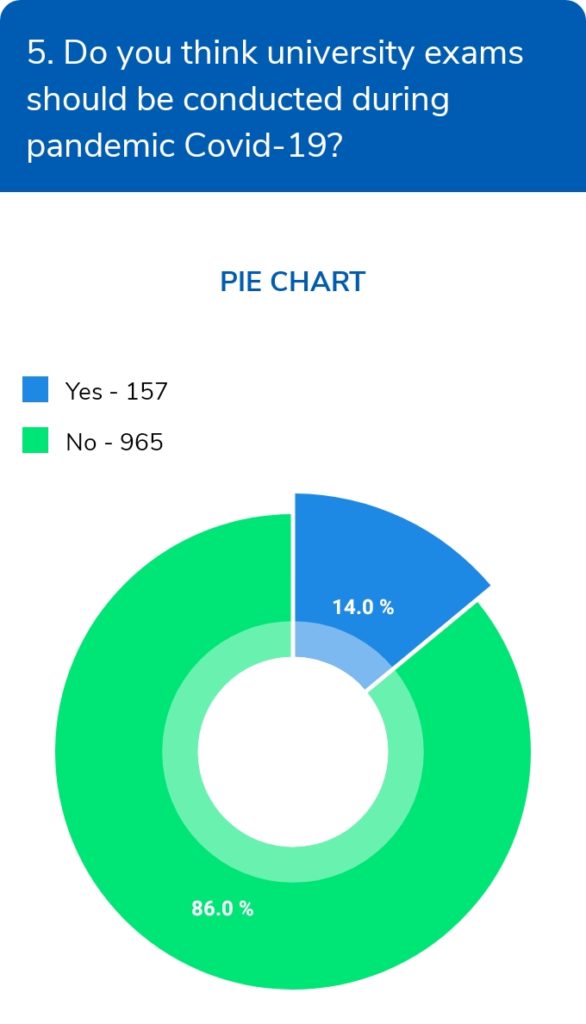
- On the question of whether university exams should be conducted during Pandemic Covid-19, 86% of the respondents were against exams while 14% of the respondents were in favor of conducting examinations. Most of those who were in favor of examinations were from the final year of their courses and were excited for the career ahead.
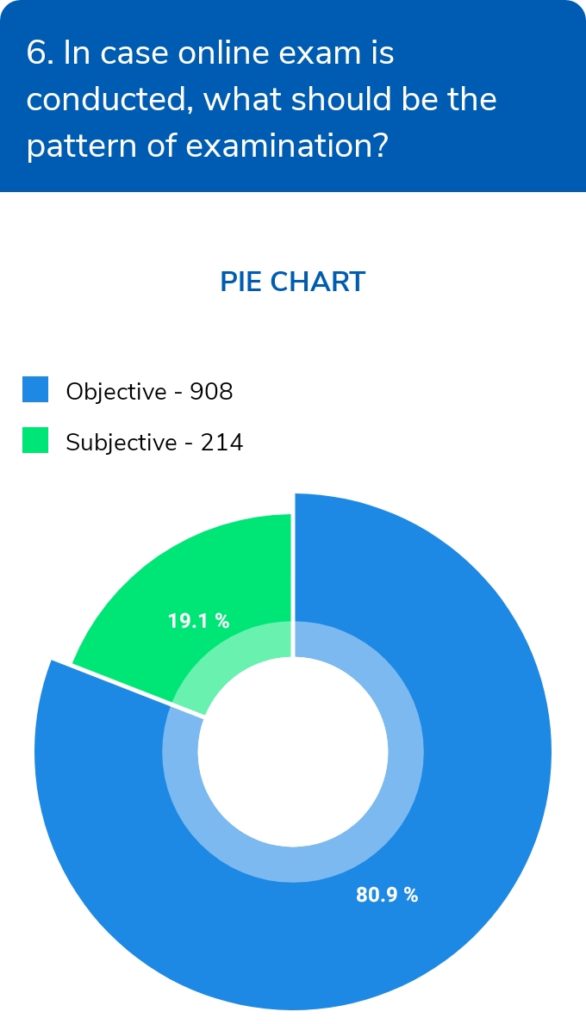
2- On the question of the pattern of examination, if online examination is conducted, 81% of the respondents suggested for objective pattern while only 19% of the respondents advocated for subjective pattern of evaluation.
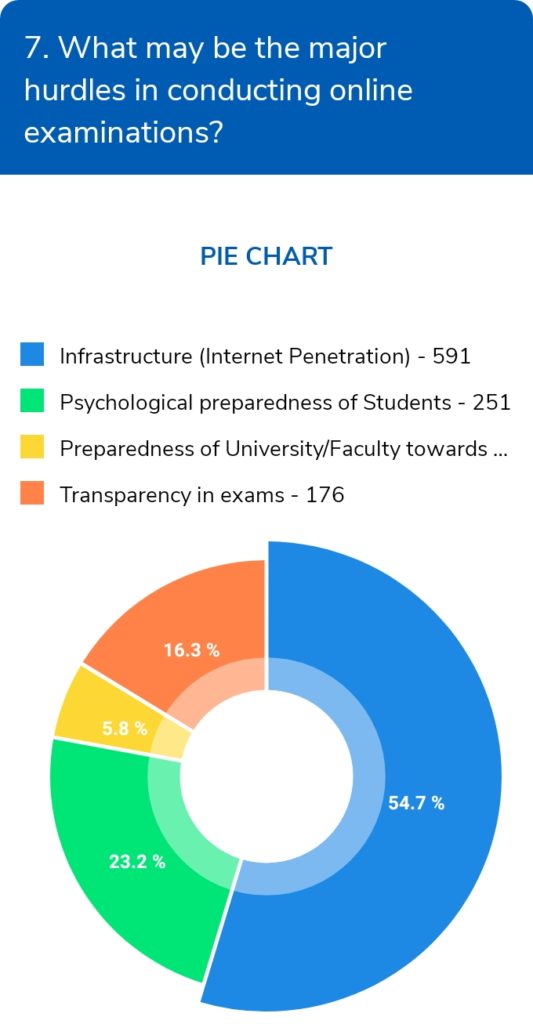
3- When asked about the major hurdles that may come across during online examination, about 55% of the respondents believed infrastructure for e-learning as the major hurdle in the evaluation process. Around 22% of the respondent termed psychological preparedness of the students as the major hurdle while about 16% were of the view that transparency can be a big issue in online evaluation. Only 5% respondents believed preparedness of university/faculty as the area of concern in online evaluation.
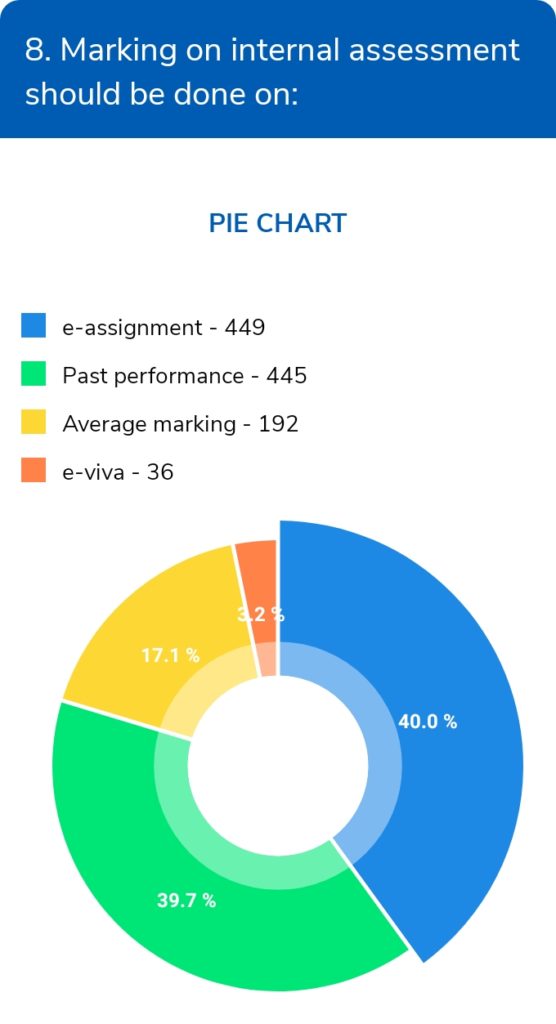
4- On the matter of what should be the marking parameter for internal assessment, e-assignment and past performance were suggested by around 40% respondents each whereas, around 17% respondents supported average marking as the criteria for internal assessment. Merely around 3% were in favor of choosing e-viva as the basis of internal assessment. Poor internet connection and lack of preparedness of students may be the primary reason for such a low interest towards e-viva.
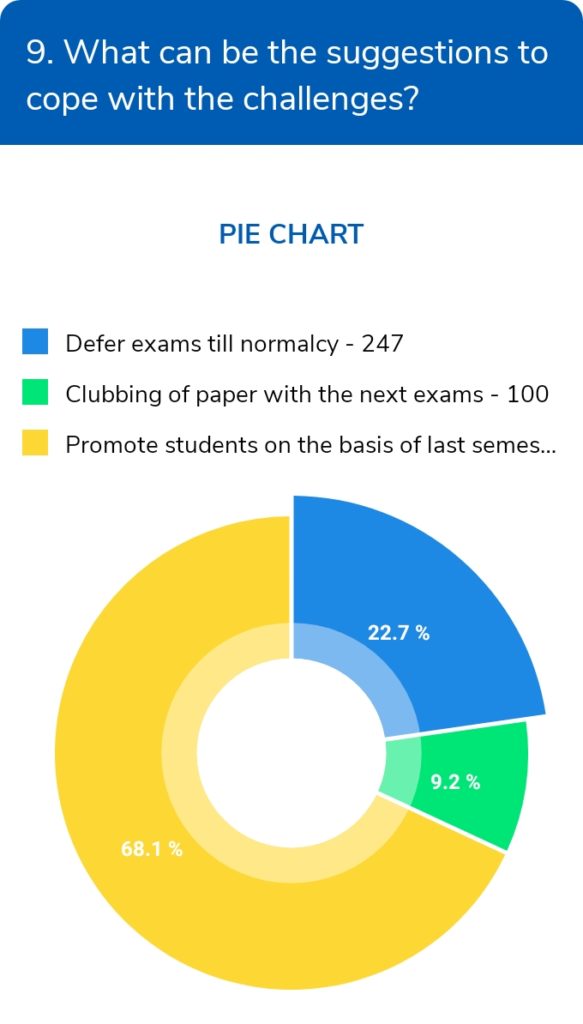
5- When asked about the suggestions for coping with the challenges in evaluation of students, majority of respondents around 66% vouched for promotion on the basis of past performances. While 22% of the respondents backed deferment of examinations till normalcy, around 9% supported clubbing of current papers with the further semester examinations.
Suggestions-
Considering the severity and the highly contagious nature of Pandemic Covid-19, the situation for conducting offline examination in next couple of months seems quite grim. Keeping aside offline exams, universities are left with very limited feasible options. Single-size-fits-all approach may not work for all the students as they have diverse curriculum with differentiated necessity. Conducting online objective pattern examination for practical and application based subjects may not be fruitful and feasible. Similarly, subjective pattern are not a feasible option for all the students without compromising with the transparency and fairness of the evaluation. Infrastructural challenges and accessibility to study materials remain a persistent problem for the remote location students. Amid such a worrisome situation, psychological preparedness of students towards evaluation remains a big concern. The most critical concern is for the final year students who are eager to move on with their exciting career ahead. Implementation of suggestions requires a proper brainstorming as well as analysis of pros and cons. A mix of various options insinuated below may be used after giving due consideration and thoughts:
- Defer Exam till normalcy- Examination of students who are not in final semester of their respective course may be deferred till the return of normalcy. For the time being they may be promoted to the next semester. In fact, as per specialized committees’ recommendation, even the current session can be deferred by 3-4 months.
- Reduction in remaining course Syllabus- In order to reduce the burden of students, remaining syllabus of course may be shortened keeping in mind the relative relevance of subjects/topics in current scenario.
- Clubbing of current semester subjects with subsequent semesters- This option may also be exercised for the students who are not in their final semester. Subject group of current semester may be systematically distributed and clubbed with subsequent semesters.
- Open Book Examinations- As per this method, students should be provided with questions and appropriate time required to write the examination along with an option to access study materials. Question paper should be sent through students’ portal online and students would be required to write the paper and upload the scanned answer sheet on the portal within the allotted time period. In order to exercise this option, at least 30-45 days notice should be given to students and a demonstration video of the examination process should be uploaded as a tutorial on the students’ portal.
- Examination on Rotational Basis- Since lockdown restrictions are expected to ease in the coming days, university can issue final year students an e-pass citing important examination. Travel advisory related to social distancing norms should be issued and proper arrangements should be provided for the students to travel for attending examination. Appropriate structured arrangement for lodging and food for the students should be made keeping in consideration the protection from the pandemic. Availability of sanitizer and masks should be made to meet the recurring demand of students in the course of stay. Examination of students should be held on rotational basis i.e. if required; examination of students of all the faculties/departments should be avoided on common day. Students should be positioned at adequate distance while conducting examination and if enough space is not there, inter-departmental exchange of examination hall could be used for successful conduct of examination. No candidate should be permitted without mask and full sleeve dress code should be made mandatory for appearing in exams. Adequate availability of unused masks and sanitizer should be ensured at examination centers.
- Promote students on the basis of past performance- Since postponement of examination of final year students does not seem a viable alternative, this option can be exercised for the final semester students whose cumulative average of past performance over the course duration can be used as the parameter to allot marks in the current semester. However, this measure has to be used cautiously as some students might resist this measure as their performance in previous semesters might have been affected by some abnormal incidents and some might be facing backlogs in the past semesters due to some unavoidable circumstances. Grievance of those students should also be taken care of while exercising this alternative.
- Promote students on the basis of average marking- For such marking, average marks obtained by final semester students in the previous year in respective faculty/institute may be used as a base to allot marks to current semester students. However, this option can only be exercised if consent of all the students is taken and should be used as the last option, as exercising this can be problematic and may draw flak from the student community.
- Future-orientation based on modern and innovative technologies- University should adopt learning and evaluation system based on modern and innovative techniques. Accessibility to digital mode and e-infrastructure should be provided to all the students with adequate training for operation mechanism.
Conclusion:
There is no denying the fact that the prevailing situation of the pandemic is gruesome and possibility of restoration of normalcy seems a distant dream and an optical illusion. As per the World Health Organization (WHO) and Indian Council of Medical Research (ICMR), the worst phase of Pandemic Covid-19 is yet to come and situation may become brutal in the coming months unless and until proper preventive measures is taken. There appears no sign of development of credible vaccine in coming few months. Amid such situation, education sector has been adversely affected given the transition phase of academic session falling under the course of pandemic. There is widespread cloud hovering over the successful conduct of offline examination of all the students. Most affected are the final year university students and those who were about to start their college life. Final year college students who have got placement and are required to join the respective organizations are worried about their future options. Amid all these prevailing circumstances, a digital survey has been conducted to inquire into the mindset of students of B.H.U. towards possibility of online examination. Around 1100 students enrolled in B.H.U. were surveyed on some pre-determined questions relating to challenges and suggestions for the online examination. This report has inculcated all such challenges and suggestion along with some additional feasible and practical approach which may prove to be beneficial in coping with the existing situation and providing future courses of actions. With a view that this report would be helpful in coming out of this problem, it specifically highlights the essence of examination of final semester students through various available alternatives and vouches for postponement of examination of those who are not in their final semester. Premiere institutions such as B.H.U should also brainstorm and adopt the tech-friendly and digital mode of learning and evaluation so as to keep pace with the digital word and avoid any hurdles like pandemic Covid-19.
(This report has been prepared by Anand Kumar Mishra, Vikrant Singh and Vipin Vihari Ram Tripathi)